My New D3M Is Quiet, Powerful, and Ready
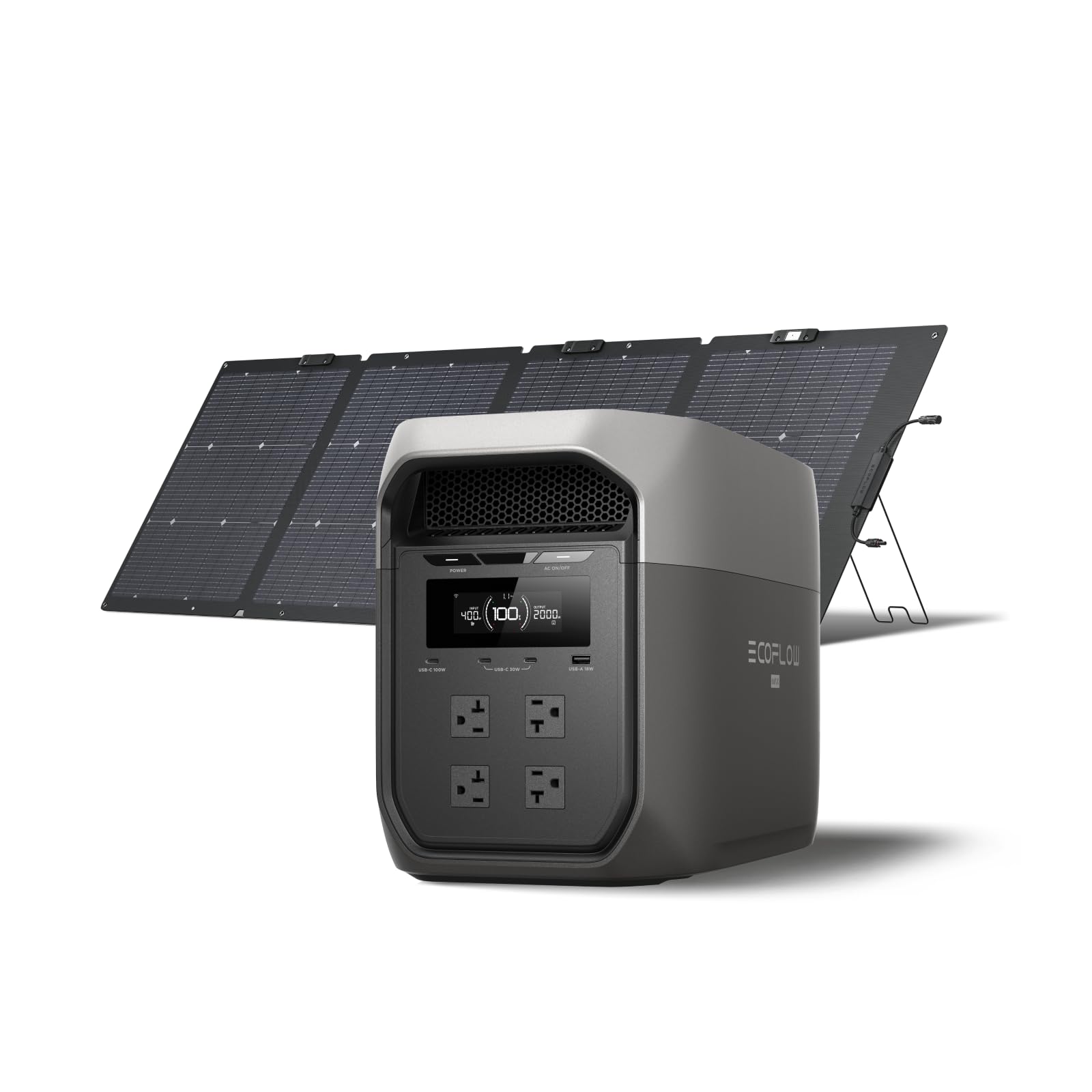
I’m so excited I finally was able to purchase the EcoFlow DELTA 3 Max.I’m definitely not new to EcoFlow. I already have the Delta 2 Max and the Delta 3 Ultra, so I’ve been saving up for the D3M for a while now. Feels good to finally add it to my collection.I don’t even need to get into all the specs because anybody interested can read those for themselves. We already know it’s packing 2048Wh and 10ms UPS. This is a powerful units for us during outages and everyday life.I also appreciate how quiet it is compared to my D2M, that I notice immediately. The D3M sounds great, looks great and not as heavy as D2M. (Note, I love my D2M😊)I have confidence that when the weather gets bad or the power goes out, I’m not to worry, I will be good with my EF. I hated that feeling of sitting in the dark wondering how long the power would be out or if my food in the freezer was make it. Now when the weather gets bad, I don’t panic I just sit in peace.I will and can use the DELTA 3 Max to run the freezer, charge everybody’s phones, run the video game and TV for the grandkids, I also tested the D3M on the microwave and the air fryer and it runs perfect (we got to eat). I’m just trying to keep my home feeling normal when things outside is crazy.Since we’re on the subject of crazy. The cost of electric bill, gas and water is going up so I will be using my unit to cut the cost of my electricity bill with EF. I see a big savings in that with solar panels yep get that free energy from the sun and speaking of solar panels.I also got the EcoFlow NextGen 220W Bifacial Portable Solar PanelThe 220 W solar panel is lightweight, compact and portable to carry and it includes the solar to XT60 charging cable to make it easy to plug in to your new D3M or any of your EF’s units .The 2-in-1 solar panels gives a 220W primary side and 155W–175W rear side, with 30-60° adjustable angle bracket that help it stand that’s a new upgrade from the old panels and integrated solar angle guide to help you find the sun☀️.OkFor me personally, EcoFlow has been reliable. I’ve been using their products since 2023, and the DELTA 3 Max feels like a solid mix of backup power, convenience, and real-world usability. I LOVE ITIt’s not perfect though. I do wish the solar input was higher, and D3M can’t support expandable battery ( D3M+ supports EB and a higher solar input), but for my need I’m ok, because overall, I’m genuinely happy with it and can already tell it’s going to get a lot of use during storms, outages, and everyday backup power situations.On a different note, I was reading that the product comes with a five-year warranty, which includes a three-year standard warranty and a two-year extended warranty available upon registration of the product on the EcoFlow app. Therefore, please ensure that you register your EcoFlow product on the app to receive the two-year extended warranty.
YYuenX
10 de octubre de 2025
Really fast charging with excellent engineering. Useful 220W solar panel for larger batteries
EcoFlow announced the Delta 2 power station at IFA Berlin 2022 with the tagline of: “Not Just a Battery.” It was available for purchase on September 16, 2022. After their excellent Delta Pro we reviewed not too long ago for our vacation home, we were very intrigued by what this new product could do, and how it would compare against Goal Zero and Jackery. We were impressed and highly recommended it.Three years later, we reviewed the Delta 3 (which now is called the Delta 3 Classic) and continued giving our recommendation. Now, the company has released the Delta 3 Max and we were more than happy to buy and check it out.I will also provide a brief summary for the EcoFlow 220W Bifacial Solar Panel at the END of the review.DIFFERENCES: Delta 3 (Classic) vs Delta 3 MaxThe Delta 3 Max provides double the battery capacity and 33% more output power than the Classic. The Max Plus (which we did not buy) could have its battery capacity expanded to 10,000Wh compared to the Classic's 5,000Wh. Both the Classic and Max still charge very fast from 0 to 80% in less than an hour. One should note that the Delta 3 Max Plus provides even more capabilities than the Max that we bought.Now on to a more extensive review of the Delta 3 Max.The Delta 3 Max's 2,048Wh battery capacity — how long something can run for — gives it double the runtime than 1,024Wh power stations that I consider to be the sweet spot for most consumers. Those include the Goal Zero Yeti 1000, Jackery Explorer 1000, and its own predecessor, the EcoFlow Delta 3 Classic. EcoFlow, Jackery, and Goal Zero have all witched from NMC battery chemistry to Lithium Iron Phosphate (LiFePO4). There are significant differences between both Lithium-ion (Li-ion) battery chemistries that I will detail shortly.How much energy a battery can store is measured in Wh (Watt-hours), and how much power is used or produced in W (Watts).EcoFlow, Goal Zero, and Jackery power stations can be used while simultaneously charging themselves.BATTERY TECHNOLOGYThere has been a lot of debate on whether Nickel Manganese Cobalt (NMC) or Lithium Iron Phosphate (LiFePO4) is better. Both are Lithium-ion batteries. LiFePO4 is bulkier and heavier, and so why would one want them? They hold some important advantages over NMC:- Safer, less volatile, and thus cheaper to manufacture- Charge cycle: 1500-2000 (10+ years)-- NMC: 20-25% capacity loss after every 500 cycle (6-10 years for up to 2000 cycles, after which capacity is vastly diminished)- Usable in more extreme temperatures (-4F/-20C to 176F/80C). NMC: only 140F/60C max- Holds 350-day charge. NMC: 300LiFePO4 batteries are less volatile (safer), more usable in extreme temperatures, and have a higher charge cycle count (battery lifetime) than NMC.CAUTION: Lithium-ion batteries do NOT like to remain discharged at 0% for prolonged periods of time. If you let your battery stay at 0% for too long, you may not be able to charge it again without specialized equipment.CONTINUOUS VS PEAK OUTPUTIt is important to understand the difference between Watts and Watt-Hours. How much power is used or produced is measured in Watts, and how much energy a battery can store is calculated in Watt-Hours. See the “Calculations” section below for more details.How much energy a battery can store is measured in Wh (Watt-hours), and how much power is used or produced in W (Watts).- AC Inverter: Converts battery (DC) power into AC-- Delta 3 Max provides 2,400W continuous output with a 4,800W peak- Peak/Surge (Starting): Nearly every device initially draws extra power to turn on. The highest amount it pulls is the Peak. As long as that number is below 4,800W, it can be STARTED. Examples…-- Turns on OK (PEAK under 4,800W):--- Freezer starts at 400W (peak), runs at 150W once on-- Will NOT turn on (PEAK over 4,800W):--- Some very heavy-duty power appliance starts at (a made-up number since I don't know any that would use that much power) 5,000W (peak), runs at 2,000W once onMost devices power on at a higher (Peak) wattage than when they are already on (Continuous). Therefore, if its peak exceeds the power station's max, it may not be able to start- Continuous Output (Running): Once devices are on, as long as they keep drawing less than 2,400W total, they will stay ON until the battery runs out-- CONTINUES running (under 2,400W)--- 100W TV + 60W laptop = 160W-- COULD STOP running (over 2,400W)--- Temporary overdrawing beyond 2,400W for a few seconds is okay. A quality BMS will protectively shut down the battery if the surge does not end after a while. Regularly going over for a prolonged time can ruin the battery in the long run--- 1,000W machine (2,100W peak) + 300W appliance (500W peak) + 700W appliance (900W peak) + 800W appliance (1,100W peak) = 2,800W. Probably will stay on for a short period---- Add 1,000W mower (1,400W peak) = 3,800W. Battery will definitely shut downCALCULATIONSThe below calculations are rough ESTIMATES as conditions, battery quality, and age can vary. [SORRY: I had to shorten my original review by a LOT (including many calculations) so it could fit here on Amazon.]Time to Charge This 2,048Wh Power Station- Calc: Hours to charge battery = Battery capacity (Wh) / Input Wattage-- As battery approaches 75% full, the input charge will increasingly be slowed down to prevent overcharging- AC Wall: 1,800W @ 80 mins [2,048 Wh / 1,800W]- 12V Car Charger-- 120W @ 17.1 hrs (at 10A, if car supports it)Charge Time with Solar- Calc: Hours to charge battery = Battery capacity (Wh) / (Panel Wattage x [0.5 or 0.75])-- In a perfect lab, solar panels charge at the listed wattage-- Expect to only receive 50-75% on a good, sunny day (ie. 75W – 113W for a 150W panel), depending on panel's age, component quality, and weather- 200W solar panel: as fast as 13.7 hours [2048Wh / (200W x 0.75)]-- Note that the Delta 3 Max can charge at up to 1,000W via parallel-connected solar panels- Underproduction: If a panel is not making enough, adding extra ones can generate a higher, combined output- Overproduction: If the panels make more than the maximum the power station charge port can take, only the max will go throughWatts Used/Produced by a Device- Calc: Watts used or produced by device = Voltage x Amperage- Vacuum with 120V @ 9.5A uses 1,140W- Solar panel with 12V @ 10A can produce up to 120WIdeal Battery Power Station Size- Calc: Battery capacity (Wh) = Watts used by device x Hours needed for / 0.85-- 10-15% of power is lost during power conversion- 45W car fridge needed for 8 hours: Minimum 424Wh power station (45W x 8 / 0.85)FINAL THOUGHTSEcoFlow thoroughly impressed us with their Delta Pro, Delta 2, and Delta 3 power stations and quickly added the company to our list of recommended battery providers. Their newest Delta 3 Max, still a LiFePO4 product, continues improving on the Delta 3 series with double the battery capacity, 33% more output power, and double solar input capacity. It continues charging from 0 to 80% in less than 1 hour, and to 100% in 80 mins total.We continue recommending the Delta 3 series without any hesitation.ECOFLOW 220W BIFACIAL SOLAR PANELI had written a separate, detailed review for this 220W solar panel at its own Amazon product listing, and so I will provide just the conclusion from that review here.The Panel sparked my curiosity on how much better output a second set of panels built into a single product could provide. It did not wow me and required a specific, reflection-optimized environment to add any meaningful energy to the primary, front-facing panels. However, I still came away impressed because it had the potential to increase solar output for nearly the same price as Goal Zero's Nomad 200 or two Jackery SolarSaga 100.Higher-capacity solar panels like this one are essential to charging large power stations (like the Delta 3 Max this came with), especially if those batteries only accept a limited number of connected panels. The foldable design allows it to be set up and put away quickly and uses up a much smaller amount of space than rigid panels that are meant to be permanently mounted. However, it also makes it more susceptible to damage if the panels are bent at an angle of more than 30 degrees.Overall, I was very impressed by the solar charging efficiency the EcoFlow 220W provided to both the EcoFlow Delta 3 Max and Goal Zero Yeti 1500x batteries. The panel's 155W backside -- when deployed in an ideal environment -- is a welcome icing on the cake to provide just a little extra charging juice for the traveler or home prepper.


 Marca: EF ECOFLOW