PPhil in Magnolia
22 de mayo de 2013
Superb Headphones and Excellent Value (with comparison to Sony MDR-V6)
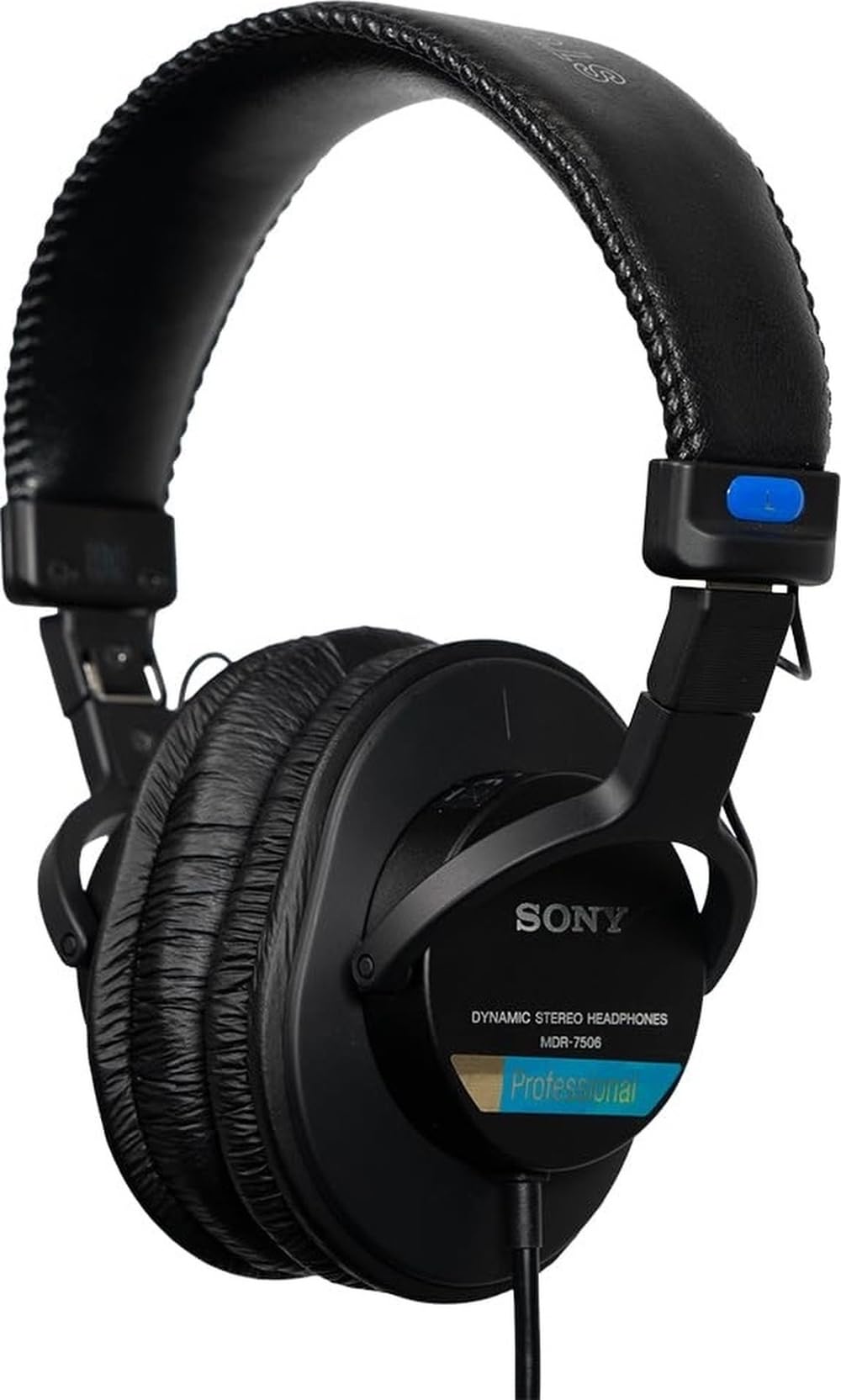
I purchased these Sony MDR-7506 headphones a couple of months ago. More recently, I've also purchased Sony's very similar (but not identical - see below) Sony MDR-V6 Monitor Series Headphones. My reason for purchasing a second pair (and getting both models) was because the V6's were very inexpensive at the time I ordered ($30 cheaper than the 7506's), and because I was curious to see if I could tell a difference between the two. In reading many of the reviews here on Amazon and elsewhere, I knew that the two are constructed very similarly but there were different opinions regarding both the differences (if any) and which has the superior sound.These are both headphones in the $100 and below price category, which seems like a reasonable price to pay for high quality sound. I do not like to listen to music using earbuds, I prefer this style of "over-the-ear" headphone. although it does take some getting used to. I also have very inexpensive Koss KSC75 Portable Stereophone Headphones for occasions when I don't want to use my more expensive Sony's.I am very satisfied with the sound quality from these headphones (both models), and with the comfort. They are the first "quality" headphones that I have owned, and the level of detail in the sound, lack of distortion, and overall quality is simply superb. I am completely satisfied.Now, regarding both similarities and differences between the Sony MDR-7506 and Sony MDR-V6, here is what I have found:- externally, they are almost identical in construction and appearance. The V6 has red stickers on each headphone "for Digital", and the 7506 has blue stickers "Professional". The phono jack for the V6 is silver metal (all metal), for the 7506 is gold (rubber and gold). Those are the only visible differences I am able to detect.- when I listen to the two headphones back to back, at the same volume level and with the same music, I can detect a slightly clearer treble and midrange from the 7506, and very slightly clearer sound. This is consistent with several of the other reviewers on Amazon for the 7506, who say they can detect a slightly better sound separation and more open sound for the 7506, with the V6's sounding a bit warmer. One reviewer also says that the internal grounding for the two headphones is different - the 7506 uses a separate internal ground for the left and right channels, where the V6 uses a single ground for both channels. (It seems to me that both grounds are going to the same place anyway, but if this is true - and I am not able to confirm whether or not it is - then maybe this contributes to a slightly different sound).- some reviewers state that the internal speaker drivers are different for the two headphones. However when I went to Sony's website to check the specifications for the two models, that is not what I found. And here is what the Wikipedia page states for these headphones: "both models share the same part number for their driver, but the magnet therein is known to vary. The MDR-7506 was introduced with a samarium-cobalt magnet, as is currently used in the MDR-V6. However, at some point, the MDR-7506 switched to the slightly more powerful neodymium magnet. These changes were made without changing the driver part number."- The box for the 7506 states "neodimium magnet". The operating instructions included with the V6 state "samarium cobalt magnet". Possibly either or both of these are out of date (as Wiki states, they may make spec changes over time) - the 7506 box is copyright 1994, and the V6 copyright is 1996.- The 7506 box includes an exploded view and parts list, which is very nice to have. The V6 box does not.- Both headphones include a soft case for storing/carrying the headphones, and both include an adaptor plug so that the headphone can be used with either a stereo mini-plug or a normal size plug.UPDATE 7/22/13 and 7/30/13: The Sony MDR-V6 and MDR-7506 headphones have just recently been reviewed by CNET, with similar comments to my own regarding the small differences in sound quality. Both headphones receive a very high recommendation from CNET. See the MDR-7506 review at [...] and the MDR-V6 review at [...]According to the specifications on Sony's website (which should be up-to-date), the only difference between the two headphones is frequency response:- MDR-7506:- Neodymium magnet, 40.0 mm driver, 10-20kHz frequency response, 63 Ohm impedance, 106 dB/W/m sensitivity- MDR-V6:- Neodymium magnet, 40.0 mm driver, 5-30kHz frequency response, 63 Ohm impedance, 106 dB/W/m sensitivityI am not able to explain how Sony is claiming different frequency response for the two headphones if all of the other specs are identical, but this is what they are saying. And I do believe that the two headphones have slightly different sound.Although there is a slight difference between the 7506 and V6, the sound from both headphones is very neutral. The "professional" choice between the two seems to be the 7506, and it is the more expensive model. If you read other reviews you will find that the 7506's are commonly used by studio engineers, because they are designed to reproduce the sound just as it is, without adding emphasis to the bass as some other headphones are designed to do. At this point, for me they are both excellent, and for thirty bucks less I'd go with the V6 if I could have only one of the two.I've been using these headphones with the Audioengine D1 24-bit digital-to-audio converter, and I am extremely pleased with the quality of the sound.As a final comment, some owners of these headphones comment that the ear pads wear out over time, and some owners also prefer different ear pads for better comfort. I also purchased a pair of Beyerdynamic EDT 250 Velour Padded Earcushions for this reason, and although I have not yet given them a try to compare them with the ear pads that come with the Sony headphones, I do like the fact that it is possible to fit different ear pads if desired in order to provide more comfort, as well as replace them when they have become worn (some owners use these headphones for many years).I notice that there are a very large number of reviewers for these headphones, many of them long-time owners who feel very strongly that these Sony headphones are the best. I'm just beginning to use them, but I have high hopes that they will be durable over time and that I will continue to be as satisfied with them as I am today.
Comfortable With Excellent Sound Quality
I love these headphones. The sound is wonderful with deep clean bass and crisp highs. Individual instruments and vocals are clearly distinguishable, at times seeming to float around me. The ear pads fit snugly but comfortably, even with my glasses on. When combined with the closed back design of the headphones, outside sounds are strongly blocked, making it easier to fully enjoy the music. While the coiled cord is longer and heavier than I need for everyday use, it is only a minor issue for me, and it is better than being too short. The folding feature and the provided case are helpful for reducing storage space.While I realize that music and sound quality are subject to individual perception, I think that many people would enjoy these headphones if they are looking for a high quality pair.
Oldie but a goodie
These headphones are amazing, especially for the price. These headphones were introduced in 1991, so surely something in this price range has come along that is better, right? What I found, nope. These are still the king. I researched several headphones before making this purchase. I narrowed it down to these (Sony MDR-7506) and the Audio Technica ATH-M50, which at the time of this review, were $50 more than the 7506. I had seen both headphones recommended numerous times. Luckily for me, 2 co-workers had the 7506 and the M5's, so I was able to AB test both.I listened to a variety of music on each pair. Here's what I found:Sound:• Treble - The 7506 is a fairly bright headphone. It does tend to push the highs a tad, but I didn't mind it. I didn't find it painful to listen to, even after an extended period, and I liked the detail that it brought out in some songs. The M50 did not seem to push the highs as much, but to me, it felt a little bit more restrained and almost muffled sounding compared to the 7506. Not bad, just not as "airy". Overall, I preferred the 7506• Mid-range - Both headphones did well in the mid-range, but I thought the 7506 was overall more clear.• Bass - This is where I thought the M50 would win hands down. After many reviews that I read, I expected the 7506 to really get trounced here. This was definitely not the case. It could be just my tastes in sound, but the 7506 had very tight, detailed bass. The M50 had slightly stronger bass, but not quite as detailed as the 7506. I would guess, like many things audio, this will be largely subjective on which you prefer. I did not find that the 7506 was lacking at all in bass, though.• Comfort - This was probably the biggest plus for the 7506 vs the M50. The M50 felt much heavier to me and squeezed my head a lot more than the 7506. The 7506 were light and much more comfortable. Complete win for the 7506. The pair I tried had the Velour ear pads, which may have helped with this. I highly recommend those as well. You can find them here: http://www.amazon.com/Beyerdynamic-Velour-Earcushions-MDR7506-Headphones/dp/B0016MF7W2• Price - Even with the upgraded ear pads, the 7506 came in over $30 cheaper. Win for the 7506 here.• Build quality and durability - Both sets of headphones seemed very well built and durable. I don't see any immediate issues with either pair. I've heard many people with 7506 that have owned them for 10-20 years with no issues except for needing to replace the ear pads. I also read numerous people with M50s since they launched (5 years ago) with no issues either.Conclusion:Not surprisingly, I ended up purchasing the 7506. They were cheaper and I liked them better all-around. I'm sure there are other people that would do the same AB test and prefer the M50, so your mileage may vary. I actually ended up purchasing 2 sets so I could have a set at work and a set at home. Highly recommend these headphones and get the Velour pads as well as they are a very worthwhile upgrade.
Impulse purchase turns out to be worth it!
First off, these were an impulse buy to use with the Orange Crush Mini guitar amp since the built in speaker kind of sucks. I wasn't really planning to use them for anything else, but curiosity got the better of me.I've had to edit this review a bit since my thoughts have changed with extensive testing and even some experimenting with two different DACs.The short version? Buy them. If you're on a tight budget and don't want to do any thorough research, these headphones WILL be revealing in ways that may not alway be appealing, which is precisely the point. They've been on the market since 1991 and easily beat a pair of modern hybrid IEMs that were twice the cost.First impressions:The Sony MDR-7506 seem well built for the price and are actually quite comfortable. They are lightweight with soft padding, and they don't seem to apply too much pressure at all. Your mileage may vary of course since I've got a smaller head, and some reviews have complained about their fit.I'm glad they include a 1/4" adapter but was surprised to find that it actually screws on. I've never seen that before, but it seems like a good idea since it won't come unplugged like a normal adapter, especially if the cable is stretched out.The adjustable band is marked with numbered shallow notches, but it seems there is not enough friction to keep the cans from sliding out of position with regular handling, so be sure to check the adjustment prior to each use. Bit of a letdown, but certainly not a deal breaker by any means.I love that the coiled cord is not too stiff or springy, but is quite flexible and will stretch out with great ease while still retracting to its original length when allowed. This is critical since the tiny guitar amp could otherwise tip over and get dragged right off the desk with a stiff cable.Every other coiled cable I've seen was so stiff it would pull the cans right off your head and would even retain a bit of stretch if pulled too hard for too long, but this one seems to be of high quality and should not put too much strain on the ends, which are weak points on any cable.Sound:Now for my entirely subjective and probably unreliable analysis of their sound. Apparently these do have some emphasis of the higher frequencies above 2kc according to frequency response graphs, which is good news for me.I should mention that I have severe auditory neuropathy which makes me deaf to everything from 10kc up, with severe loss starting at just 1kc. With the right set of phones and proper EQ, I can hear pure tones up to 8kc, but hearing loss is more complex than just boosting certain frequencies and there's not much more I can do without using some rather sophisticated DSP software on a laptop.With all that said, I've been using the Ikko Gems OH1S IEMs for the last four years, paired with the EarStudio ES100 MkII DAC which does have a built-in 10 band EQ but is sadly discontinued. Fearing the inevitable I've since upgraded to the Qudelix 5K DAC which is even more sophisticated with its 10 band true parametric EQ and was purchased just a day after these headphones. Settings on the Qudelix 5k are as follows with frequency, dB and Q values in that order.31.5: 0, 1.41463: -7.5, 1.0125: -12, 0.7250: -15, 0.7500: -12, 0.72k: 2, 1.4141k & 4k to 16k: 0, 1.414I can hear quite a surprising portion of the highs, and it's remarkably smooth compared to the IEMs. This is unusual for dynamic drivers, but of course some detail is missing since balanced armatures are more suited to my hearing loss. Generally I'm leaning more towards the smoother sound of the Sony.There is no apparent emphasis in the lows or mids, which may be why I thought music was boring in these headphones. Over time as they're breaking in I'm finding this to be more than welcome. Nothing seems to stand out in a way that it shouldn't, unless the mix was made that way.The bass is simply phenomenal. Clean, clear and well articulated, it can be quite mild mannered or it can hit you like a hammer. The low end reaches quite deep but never sounds bloated or muddy. I've never heard so much variation in the bass between songs, and it really does make music more exciting.Overall clarity seems to be on another level compared to the IEMs. Instruments and vocals are all clearly distinct and well separated, and the sound stage can be kind of wild on some tracks, though I'm feeling this may be influenced in part by the DAC as well since there seems to be some difference between the ES100 and Qudelix 5k. Trying to do A/B testing is hard without two separate pairs of these headphones, but for the most part they appear to be even more capable of extracting musical details which otherwise might be lost in the mix. They can handle dense mixes with grace, keeping things well defined even when it gets pretty hairy.I thought using studio monitors for casual listening was supposed to suck, but if anything it's the exact opposite with these. Oh sure, they won't do any favors for bad mixes, I've heard it myself. But a good mix is actually more enjoyable on these phones with the right EQ settings.I just wish they had a balanced cable since the crosstalk on the Qudelix 5k is not the best for the 3.5mm port. Aside from that, I'm seriously considering buying a second pair just to have as a backup. They really are that good, even by my flawed hearing and limited abilities to correct it.I would highly recommend them for studios on any budget, and casual audiophiles who don't want to (or can't) spend a fortune on headphones.


 Marca: Sony